Cloud Cost Allocation: A Strategic Guide for Technology Leadership
Executive Summary
In today’s cloud-first business environment, proper cloud cost allocation through comprehensive resource labeling is not just a financial necessity—it’s a strategic imperative that directly impacts your organization’s ability to scale profitably and compete effectively. Cloud cost Allocation, also referred to as Transfer Pricing is the mechanism used to assign costs od shared cloud resources such as infrastructre, data platforms or managed services to different business units, departments or teams within an organization. Organizations that excel at cloud cost allocation can achieve an additional 10–20% in cost savings beyond standard optimization practices. In contrast, those without clear cost allocation risk poor decision-making that can hinder growth and reduce profitability.
According to recent industry research, 73% of enterprises have exceeded their cloud budget at least once, and over 33% have exceeded their budget by more than 10%. More alarmingly, over 35% of cloud spending is wasted due to idle or unused resources. Cloud cost allocation enables the fundamental understanding of unit economics—the true cost of delivering value to customers. Without proper labeling and allocation, organizations operate blindly, unable to connect cloud spend to business outcomes, measure the profitability of products and services, or make data-driven decisions about resource investments.
The FinOps Foundation reports that 66% of organizations are expanding FinOps into SaaS cost management, and 63% are already applying it to AI cost optimization, demonstrating the growing recognition that comprehensive cost allocation is essential for managing all technology investments, not just traditional cloud infrastructure.
The Strategic Imperative: Why Allocation Matters
Connecting Cloud Costs to Business Value
The ultimate goal of cloud adoption is to enable organizations to derive maximum business value from their technology investments. However, only 15% of enterprises can establish a clear relationship between cloud costs and business value at the use-case level. This disconnect creates a fundamental problem: how can leadership make informed decisions about scaling, product development, or market expansion without understanding the unit cost structure of their digital services?
Cost allocation (Transfer Pricing) solves this by enabling unit economics analysis—the practice of calculating the cost of delivering a single unit of business value. Whether that unit is a customer transaction, a user session, or a product feature, understanding these costs allows organizations to:
- Determine the breakeven point for new initiatives
- Identify which services generate positive ROI
- Make informed decisions about scaling operations
- Calculate the true cost of customer acquisition and retention
Alignment with FinOps Framework
Cost allocation sits at the heart of the FinOps Framework, specifically within the “Understand Cloud Usage & Cost” domain. This domain focuses on gathering all information required to perform FinOps, including direct and imputed cloud costs, usage data, and organizational metadata to categorize and allocate costs. The allocation capability enables organizations to:
- Define strategies to assign and share cloud costs using accounts, tags, labels, and other metadata
- Create accountability among teams and projects within the organization
- Validate allocation compliance and maintain allocation taxonomies
- Document apportionment of shared costs and impacts to allocation targets
Problems Solved by Strategic Cloud Cost Allocation:
Finance Teams: Financial Governance and Compliance
Finance teams face unique challenges in managing cloud costs, and proper allocation addresses these directly:
| Challenge | Solution | Business Impact |
|---|---|---|
|
Cost Center Mapping |
Automatic allocation using standardized labels is a core requirement. |
Eliminates manual tracking, reduces billing errors |
|
Budget Forecasting |
Granular forecasting capabilities are essential for finance teams |
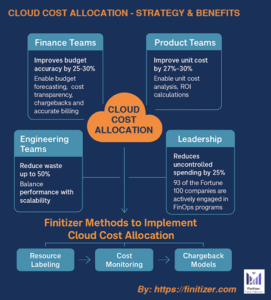
Improves budget accuracy by 25-30% |
|
OPEX vs COGS Classification |
Automated expense categorization is critical for SaaS companies and cloud-first organizations |
Ensures accurate financial reporting and margin analysis |
|
Compliance Tracking |
Standardized labeling significantly reduces audit preparation requirements |
Reduces compliance risks and audit preparation time |
|
Chargeback and Show-back Implementation |
Detailed cost attribution enables effective show-back/chargeback models |
Enables show-back/chargeback models for accountability |
Key Statistics for Finance Leaders:
- 60% of organizations encounter cloud cost overruns that negatively impact their business
- AI-powered FinOps tools cut cloud expenses by greater than 20% on average
- Improves budget accuracy by 25-30% and can achieve forecast variance as low as 5% for mature FinOps practices.
- Standardized tagging and labeling can reduce cloud waste by 20-30%.
Product Teams: Profitability and Investment Optimization
Product managers require detailed cost visibility to make informed decisions about product development and pricing:
| Challenge | Solution | Business Impact |
|---|---|---|
|
Unit Cost Analysis |
Calculating true cost per transaction/user/feature is indeed fundamental for data-driven pricing decisions |
Enables data-driven pricing decisions |
|
ROI Measurement |
Connecting cloud costs to product outcomes is critical for investment optimization |
Improves product investment decisions by 15-25% |
|
Competitive Analysis |
Understanding cost structure versus competitors provides significant strategic advantages |
Identifies cost advantages and optimization opportunities |
|
Feature Profitability |
Service-level cost tracking is essential for product roadmap prioritization |
Guides product roadmap prioritization |
|
Margin Analysis |
Detailed cost breakdown by product line enables accurate profitability assessment |
Enables accurate profitability assessment |
Competitive Analysis Enhancement:
- Cloud cost optimization provides competitive advantage by freeing up IT budgets for strategic projects.
- Organizations that effectively manage cloud costs can reinvest savings into innovation and growth initiatives.
Key Statistics for Product Teams:
- Only 27% of leaders say their cloud initiatives are driving more customer value.
- Organizations with proper unit economics understanding can determine breakeven points for promotions and investments.
Engineering Teams: Operational Efficiency and Architecture Optimization
Engineering teams benefit from real-time cost visibility that influences architectural and operational decisions:
| Challenge | Solution | Business Impact |
|---|---|---|
|
Service-Level Cost Tracking |
Monitor cost impact of deployments |
Encourages cost-conscious development practices |
|
Resource Optimization |
Identify underutilized/orphaned resources |
Reduces waste by 30-50% through optimization. In some cases Research shows cloud optimization can reduce costs by up to 72% |
|
Architecture Decisions |
Cost-informed architectural trade-offs |
Balances performance, scalability, and cost |
|
Environment Management |
Automated cleanup of temporary resources |
Reduces non-production costs by 40-60% through automated scheduling |
|
Deployment Accountability |
Track costs by team and service |
Creates ownership and responsibility for resource usage |
Advanced Environment Management:
- Automated scaling and scheduling can achieve up to 90% savings for flexible workloads.
- Infrastructure as Code (IaC) enables consistent cost-optimized deployments.
Key Statistics for Engineering Teams:
- 82% of organizations waste at least 35% of their cloud spend.
- Automated scaling and scheduling can achieve up to 90% savings for flexible workloads.
- Proper tagging and labeling can reduce cloud waste by 20-50%.
Leadership: Strategic Decision-Making and Governance
Executive leadership requires high-level visibility into cloud investments and their business impact:
| Challenge | Solution | Business Impact |
|---|---|---|
|
Strategic Planning |
Data-driven market expansion decisions |
Improves investment success rates |
|
Accountability Creation |
Clear ownership of cloud spending |
Reduces uncontrolled spending by 15-25% |
|
Margin Analysis |
True profitability by business unit |
Enables strategic resource allocation |
|
Risk Management |
Identify cost concentration and dependencies |
Reduces financial and operational risks |
|
Competitive Positioning |
Understand cost structure advantages |
Improves market positioning and pricing strategy |
Key Statistics for Leadership:
- 93 of the Fortune 100 companies are actively engaged in FinOps programs.
- 82% of organizations waste at least 35% of their cloud spend.
- Only 10% of organizations currently achieve 90% cost allocation.
- Overall tagging compliance must be at least 90% for effective cost allocation.
The Foundation: Comprehensive Resource Labeling
Effective cost allocation begins with comprehensive resource labeling using standardized metadata tags. These labels serve as the foundation for financial visibility, operational efficiency, and strategic decision-making. Without proper labeling, cloud costs remain an undifferentiated expense that obscures which teams, products, or initiatives drive spending.
Consider a typical enterprise scenario: a company spends $50 million annually on cloud services across hundreds of teams and dozens of products. Without proper labeling, this appears as a single, unmanageable expense. With comprehensive labeling, the same spend becomes a detailed map showing exactly how each dollar contributes to business outcomes.
Essential Label Categories and Implementation
A successful labeling strategy requires three core components: an allocation strategy, a tagging strategy, and a shared cost strategy. Each component must be carefully designed to support the organization’s specific business model and operational requirements.
The following table outlines the essential label categories that form the foundation of effective cost allocation:
| Label Name | Category | Purpose | Example Value |
|---|---|---|---|
|
Department |
Mandatory |
Organizational cost partitioning |
marketing |
|
cost_center |
Mandatory |
Financial reporting and compliance |
1025 |
|
application |
Mandatory |
Product-level cost allocation |
customer-analytics-platform |
|
service_name |
Mandatory |
Service-level cost tracking |
recommendation-service |
|
team_owner |
Mandatory |
Resource ownership identification |
ml-engineering |
|
expense_type |
Mandatory |
OPEX vs COGS classification |
COGS or OPEX |
|
env |
Mandatory |
Environment-based cost management |
production |
|
budget_manager |
Recommended |
Budget accountability |
VP-Marketing |
|
sub_department |
Recommended |
Detailed organizational breakdown |
customer-engagement |
|
initiative |
Recommended |
Project-based cost tracking |
personalization-v3 |
|
resource_classification |
Recommended |
Manage shared resources |
shared |
|
allocation_method |
Recommended |
Manage shared resources |
usage-based |
Mandatory and Recommended Labels Example
These provide additional context for enhanced reporting and analysis:
json
{
department”: “marketing”,
“cost_center”: “4025”,
“application”: “customer-analytics-platform”,
“service_name”: “recommendation-service“,
“team_owner”: “ml-engineering”,
“expense_type”: “COGS“,
“env”: “production“,
“budget_manager”: “VP-Marketing“,
“sub_department”: “customer-engagement”,
“initiative”: “personalization-v3″,
“location”: “us-west-2“,
“security_level”: “standard“
}
Shared Resource Labels Example
For resources used by multiple teams or services:
json
{
“department”: “engineering“,
“cost_center”: “3015“,
“application”: “shared-platform“,
“service_name”: “shared-data-processing-pipeline“,
“team_owner”: “platform-operations”,
“expense_type”: “OPEX“,
“env”: “production“,
“resource_classification”: “shared“,
“allocation_method”: “usage-based“
}
Business Reports and Analytics Enabled by Proper Allocation
The following table demonstrates the comprehensive reporting capabilities that proper cost allocation enables across different organizational functions:
| Report Type | Primary Audience | Key Metrics | Business Impact |
|---|---|---|---|
|
Cost Attribution |
Finance |
Cost per team/product/service |
Accurate cost allocation and compliance |
|
Unit Economics |
Product/Leadership |
Cost per transaction/user/API call |
Pricing optimization and profitability analysis |
|
Budget Variance |
Finance |
Budget vs actual by allocation |
Proactive budget management and forecasting |
|
Optimization Opportunities |
Engineering |
Underutilized resources by owner |
20-50% cost reduction potential |
|
Chargeback / Show back |
All Personas |
Departmental cost breakdown |
Increased accountability and cost awareness |
|
ROI Analysis |
Leadership |
Revenue per cloud dollar spent |
Investment prioritization and strategic planning |
|
Capacity Planning |
Engineering |
Resource usage trends |
Strategic resource planning and scaling |
|
Compliance Tracking |
Finance / Compliance |
Labeling compliance percentage |
Audit readiness and governance |
Unit Economics Dashboards
Proper allocation enables the creation of unit economics dashboards that show metrics like:
- Cost per customer transaction
- Cost per active user
- Cost per API call
- Cost per data processing job
- Revenue per cloud dollar spent
These dashboards provide real-time visibility into the relationship between cloud costs and business outcomes.
Optimization Opportunity Reports
By understanding how costs are allocated, organizations can identify optimization opportunities such as:
- Underutilized resources that can be rightsized or terminated
- Temporary environments that can be scheduled for automatic shutdown
- Shared services that can be consolidated
- Workloads that can benefit from reserved instance pricing
Automation and Enforcement
Manual labeling processes are error-prone and don’t scale. Successful organizations implement automated labeling through infrastructure as code (IaC) tools like Terraform, governance policies, and CI/CD pipelines. This ensures consistency, reduces manual effort, and enforces compliance.
Measuring Success: Key Performance Indicators
Financial Metrics
- Cost Allocation Coverage: Percentage of cloud costs properly allocated to business units
- Unit Cost Trends: Changes in cost per transaction, user, or other business metrics over time
- Budget Accuracy: Variance between forecasted and actual spending at the allocation level
- Cost Optimization Savings: Savings identified through proper allocation and optimization
Operational Metrics
- Labeling Compliance: Percentage of resources properly labeled according to standards
- Time to Allocation: Speed of allocating new resources to appropriate cost centers
- Allocation Accuracy: Precision of cost attribution to correct business units
- Resource Utilization: Efficiency of resource usage across different allocations
Business Impact Metrics
- Decision Speed: Time required to make resource allocation decisions
- Investment ROI: Return on investment for cloud spending by business unit
- Margin Visibility: Clarity of profit margins at the product or service level
- Strategic Alignment: Degree to which cloud spending aligns with business priorities
Implementation Roadmap
The following table provides a structured approach to implementing comprehensive cost allocation:
| Maturity Phase | Timeline | Key Activities | Success Metrics |
|---|---|---|---|
|
Crawl |
Months 1-3 |
Establish tagging strategy and policy governance framework |
80%+ tagging compliance |
|
Crawl |
Months 1-3 |
Implement mandatory allocation metadata across resources |
Automated tagging deployment through IaC |
|
Walk |
Months 4 6 |
Expand to recommended allocation taxonomies and reporting & analytics capabilities |
Comprehensive FinOps dashboards |
|
Walk |
Months 4-6 |
Develop unit economics tracking and business value quantification |
Cost per transaction/user/API call visibility |
|
Walk |
Months 7-12 |
Implement advanced shared cost allocation algorithms and forecasting capabilities |
Predictive analytics and scenario modeling |
|
Walk |
Months 7-12 |
Establish continuous optimization processes and workload optimization |
Automated recommendations and rightsizing |
|
Run |
Ongoing |
Deploy real-time anomaly detection and proactive cost management |
Proactive cost governance and alerting |
|
Run |
Ongoing |
Establish FinOps Center of Excellence and organizational enablement |
Cross-functional FinOps practice adoption |
Common Implementation Challenges and Solutions
Challenge 1: Achieving High Labeling Compliance
Solution: Implement automated labeling through infrastructure as code and governance policies. Use tools like Terraform modules that automatically apply required labels, and establish policies that prevent resource creation without proper labeling.
Challenge 2: Managing Shared Costs
Solution: Develop a comprehensive shared cost strategy that uses a combination of fixed allocations, proportional distribution, and proxy metrics. Consider using an “informed ignore” approach for complex shared costs where the effort to allocate exceeds the business value.
Challenge 3: Cross-Cloud Consistency
Solution: Establish cloud-agnostic labeling standards that work across all platforms. Use automation tools that can apply consistent labeling regardless of the underlying cloud provider.
Challenge 4: Organizational Resistance
Solution: Focus on demonstrating business value early in the implementation. Start with high-impact use cases that show clear ROI, and gradually expand the program as stakeholders see the benefits.
Best Practices for Success
1. Start with Business Outcomes
Begin by identifying the specific business questions you need to answer, then design your labeling strategy to support those outcomes. Don’t label for the sake of labeling—every label should serve a specific business purpose.
2. Implement Incrementally
Start with mandatory labels that provide the most business value, then gradually expand to recommended and optional labels. This approach reduces complexity and increases the likelihood of success.
3. Automate Everything Possible
Manual processes don’t scale and are prone to errors. Invest in automation tools and infrastructure as code to ensure consistent labeling across all resources.
4. Create Clear Governance
Establish clear ownership, roles, and responsibilities for cost allocation. Create governance processes that ensure labeling standards are maintained and evolved over time.
5. Focus on Data Quality
Invest in data validation and quality assurance processes. Poor data quality undermines the entire cost allocation effort and reduces trust in the results.
Conclusion: The Strategic Advantage
Organizations that master cloud cost allocation gain a significant competitive advantage. They can make faster, more informed decisions about resource investments, accurately price their products and services, and optimize their operations based on real data rather than assumptions.
The question is not whether to implement comprehensive cost allocation—it’s how quickly you can do it effectively. In a cloud-first world, the ability to understand and optimize the relationship between cloud costs and business value is not just a nice-to-have capability—it’s a fundamental requirement for sustainable growth and profitability.
The investment in proper labeling and allocation infrastructure pays dividends far beyond cost reduction. It enables strategic decision-making, improves operational efficiency, and creates the foundation for sustainable, profitable growth in the cloud era.
Organizations that delay this investment risk being outmaneuvered by competitors who can make faster, more informed decisions based on comprehensive cost visibility.
Organizations that implement FinOps practices see 10-25% additional cost savings beyond traditional optimization efforts. But the real value lies not just in cost reduction, but in the strategic capabilities that proper allocation enables—the ability to make data-driven decisions about product development, market expansion, and competitive positioning.
As the FinOps Foundation emphasizes, allocation is not just a capability—it’s a fundamental domain within the FinOps framework that enables organizations to understand their cloud usage and costs, quantify business value, and optimize their cloud investments.
The time to act is now. Start with the foundation—establish your labeling standards, implement automation, and begin building the cost visibility that will drive your organization’s future success. The competitive advantage gained from proper cost allocation will compound over time, creating sustainable differentiation in an increasingly cloud-dependent business environment.
Finitizer Assessment: Unlocking Cloud Cost Allocation
Finitizer helps you unlock the strategic value of your cloud spend through a structured cost allocation assessment and build a Transfer Pricing mechanism. We start by analyzing your current labeling, tagging, and cost attribution practices—pinpointing gaps that limit visibility and financial accountability.
Using automation, we scan for misaligned or missing labels, evaluate shared cost strategies, and benchmark your setup against FinOps best practices. Based on this, we deliver a tailored roadmap to improve tagging coverage, cost attribution accuracy, and reporting granularity.
We also help implement your allocation strategy through automation tools like Terraform modules and GCP policies, ensuring consistency and scalability.
With Finitizer, you gain the ability to:
- Greater visibility into cloud costs
- Allocate and track cost per product, user, or feature, per team
- Improve budget accuracy by additional 25–30%
- Enable chargeback/show back models for accountability
- Reduce cloud waste by additional 20–50%
- Align finance, engineering, and product teams on shared cost goals
Turn your cloud cost data into a strategic advantage with Finitizer.