Workload Optimization for Cloud Storage
Introduction
According to the State of FinOps 2025 Report, workload optimization and waste reduction remains the top priority for FinOps practitioners, with 50% of respondents consistently prioritizing optimization efforts. The cloud storage market represents a significant portion of this opportunity, with global cloud storage spending reaching $132.03 billion in 2024 and projected to grow to $639.40 billion by 2032 at a compound annual growth rate (CAGR) of 21.7%. Despite this massive investment, organizations face substantial challenges in optimizing their cloud storage costs, with an estimated 30-35% of cloud storage spending attributed to waste—representing billions of dollars in addressable cost reduction opportunities.
This white paper provides comprehensive guidance for implementing workload optimization strategies for cloud storage within the broader Data Cloud ecosystem, based on extensive real-world experience in cloud storage optimization. Implementing these optimization techniques can reduce cloud storage costs by 30-50%, while maintaining performance and ensuring data availability. The strategies outlined in this paper are applicable across all major cloud service providers and can be adapted to organizations at any stage of their FinOps maturity journey.
What are Cloud Storage Services
Cloud storage services provide scalable, on-demand data storage solutions, enabling organizations to store, manage, and access data without maintaining physical infrastructure. These services operate on a pay-as-you-use model, offering global accessibility, automatic scaling, and built-in redundancy. The table below provides an overview of major cloud storage platforms across different cloud service providers:
| Cloud Provider | Cloud Storage Service | Primary Storage Classes | Billing Unit | Standard Storage Price (per GB/month) (As of Jan 2026) |
|---|---|---|---|---|
| AWS | Amazon S3 | Standard, Standard-IA, Glacier, Glacier Deep Archive | GB/month | $0.023 |
| Azure | Azure Blob Storage | Hot, Cool, Archive | GiB/month | $0.018 |
| GCP | Google Cloud Storage | Standard, Nearline, Coldline, Archive | GB/month | $0.026 |
| Oracle Cloud | Oracle Object Storage | Standard, Infrequent Access, Archive | GB/month | $0.022 |
| IBM Cloud | IBM Cloud Object Storage | Standard, Vault, Cold Vault | GB/month | $0.023 |
| Alibaba Cloud | Alibaba Cloud Object Storage Service | Standard, Infrequent Access, Archive | GB/month | $0.020 |
Cloud storage pricing operates on a tiered model based on storage classes designed to match different access patterns and cost requirements. Standard storage is optimized for frequently accessed data, offering high performance and availability but at the highest cost. Nearline or Cool storage provides cost-effective solutions for data accessed less than once per month, with slightly higher retrieval costs. Coldline storage offers even lower storage costs for data accessed less frequently, typically quarterly, with higher retrieval costs and minimum storage duration requirements. Archive storage represents the most economical option for long-term data retention, designed for data that is rarely accessed and can tolerate longer retrieval times, often with minimum storage durations of 90 days to one year depending on the provider.
Measures of Success & Key Performance Indicators
Effective measurement and cost allocation requires continuous monitoring of specific metrics that demonstrate optimization progress and support FinOps decision-making. These metrics should consistently trend downward over time as optimization strategies and cost management initiatives take effect.
| Metric | Description |
|---|---|
| Total Queries per Day | Total count of all queries executed daily across the data warehouse environment |
| Total Query Cost per Day | The cumulative financial cost of all query operations executed within a 24-hour period, supporting cost visibility and chargeback models |
| Average Query Cost per Day | Total daily query cost divided by total daily query count, providing insight into per-query efficiency and cost per unit of work |
| Average Query Duration | Measurement of query execution time, enabling identification of resource-intensive queries that contribute to increased costs |
Measures of Success & Key Performance Indicators
Effective measurement and cost allocation requires continuous monitoring of specific metrics that demonstrate optimization progress and support FinOps decision-making. These metrics should consistently trend downward over time as optimization strategies and cost management initiatives take effect. The following key performance indicators provide comprehensive visibility into cloud storage optimization effectiveness:
- Cloud Storage Cost per Day– Daily tracking of total storage spending enables rapid identification of cost spikes and measures the impact of optimization initiatives.
- Buckets to be Deleted– Identifies storage buckets with zero read and write activity over extended periods, representing immediate cost reduction opportunities
- Buckets with Incorrect Storage Class– Measures the percentage of storage buckets using inappropriate storage tiers based on access patterns, indicating potential cost savings through proper classification
- Buckets without Lifecycle Rules– Tracks the percentage of storage buckets lacking automated lifecycle management policies, representing missed opportunities for cost optimization
- Storage Utilization Rate– Monitors the ratio of actively accessed data versus inactive data, helping identify candidates for migration to lower-cost storage tiers
- Data Transfer Cost per GB– Measures the cost efficiency of data egress and ingress operations, highlighting opportunities for CDN implementation and bandwidth optimization
Organizations should establish baseline measurements for these KPIs and set realistic targets for improvement based on their FinOps maturity level. Regular monitoring and reporting of these metrics enables data-driven decision-making and demonstrates the business value of storage optimization efforts. Success metrics should be aligned with broader organizational objectives, ensuring that cost optimization initiatives support rather than hinder business growth and innovation.
Cloud Storage Optimization Best Practices
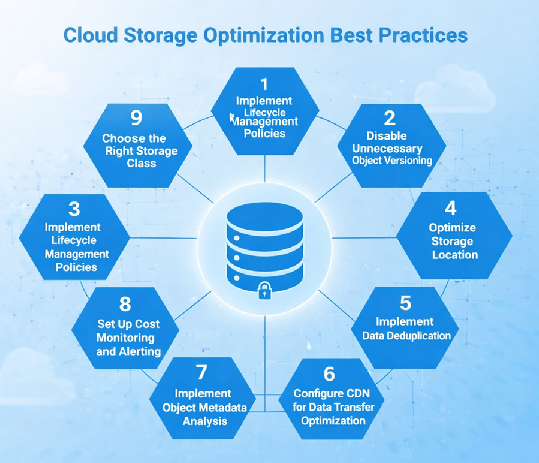
The priority of cloud storage optimization techniques is determined using a high-impact, low-effort matrix that evaluates both the potential cost savings and the implementation complexity of each strategy. Techniques requiring minimal effort while delivering maximum impact are prioritized first, enabling organizations to achieve quick wins that build momentum for more comprehensive optimization initiatives.
- Choose the Right Storage Class
Selecting appropriate storage tiers based on access patterns represents the highest-impact, lowest-effort optimization strategy. Most cloud providers offer multiple storage classes optimized for different access frequencies, with significant cost differences between tiers. For example, Google Cloud Storage Archive costs $0.0012 per GB per month compared to $0.020 for Standard storage, representing a 94% cost reduction for long-term storage. Organizations should analyze their data access patterns using metrics like ReadObject and WriteObject operations to identify candidates for migration to lower-cost storage classes.
Organizations should leverage intelligent tiering features provided by cloud providers to automatically optimize storage costs based on access patterns. Google Cloud Storage Autoclass automatically transitions objects through Standard, Nearline, Coldline, and Archive storage classes based on access frequency, with objects moving to colder storage after 30, 90, and 365 days of inactivity. AWS S3 Intelligent Tiering monitors access patterns and automatically moves objects between frequent and infrequent access tiers, eliminating the need for manual classification while optimizing costs.
- Implement Lifecycle Management Policies
Object Lifecycle Management represents a fundamental strategy for automating cost optimization throughout the data lifecycle. These policies define rules that automatically transition objects between storage classes or delete them when specific conditions are met, such as age, access patterns, or custom metadata. Google Cloud Storage lifecycle policies can automatically downgrade objects older than 365 days to Coldline storage, reducing ongoing storage costs while maintaining data availability. Implementing comprehensive lifecycle policies across all storage buckets can eliminate 20-40% of storage waste from aged, unnecessary data.
Lifecycle policies should be designed to align with business requirements and regulatory compliance needs. For example, financial institutions might implement rules to automatically archive transaction records after seven years and delete non-essential data after ten years. Healthcare organizations can leverage lifecycle policies to manage patient records in accordance with HIPAA requirements, ensuring data is retained for the required duration and securely deleted when no longer needed. Implementation typically involves defining JSON configuration files that specify actions (delete, transition storage class) and conditions (age, creation date, storage class) for automated policy execution.
- Disable Unnecessary Object Versioning
Object versioning in cloud storage services can significantly increase costs by retaining multiple versions of modified or deleted objects. When versioning is enabled, every object modification creates a new version rather than overwriting the existing file, leading to exponential storage growth over time. Organizations should evaluate whether versioning is necessary for each storage bucket and disable it where not required for business or compliance purposes.
For buckets where versioning is essential, technical teams can implement lifecycle rules to automatically delete old versions after a specified retention period. For instance, AWS S3 lifecycle policies can be configured to delete non-current versions after 90 days, balancing data protection with cost control. Google Cloud Storage provides similar capabilities through lifecycle management rules that can automatically delete non-current versions based on age or version count thresholds.
- Optimize Storage Location
Regional versus multi-regional storage decisions significantly impact both cost and performance. Multi-regional storage typically costs 30-50% more than regional storage due to increased replication and data transfer charges. Technical teams should evaluate their geographic distribution requirements and select regional storage for workloads that don’t require global accessibility. Google Cloud Platform introduced replication charges of $0.02 per GB for multi-region buckets, adding substantial costs for high-volume storage scenarios.
- Implement Data Deduplication
Data deduplication eliminates redundant files and reduces storage footprint through hash-based identification and content-aware storage techniques. Engineering teams can implement file hash comparison (MD5, SHA-256) before upload to identify duplicate content and prevent redundant storage. This approach is particularly effective for backup systems, media libraries, and document management platforms where identical files may exist across multiple locations or versions.
- Configure CDN for Data Transfer Optimization
Content Delivery Network (CDN) integration reduces bandwidth costs by caching frequently accessed data at edge locations. This strategy particularly benefits organizations with global user bases, as CDN caching reduces the need to serve repeated requests directly from origin storage, lowering both egress costs and latency. Google Cloud CDN, AWS CloudFront, and Azure CDN provide seamless integration with their respective storage services, often reducing data transfer costs by 40-60%.
- Enable Audit Logging for Usage Analysis
Cloud audit logging provides crucial visibility into storage access patterns, enabling data-driven optimization decisions and supporting FinOps cost visibility initiatives. Engineering teams should enable detailed logging for storage operations to track read/write patterns, identify unused resources, and validate optimization effectiveness. For example, AWS CloudTrail can log all S3 API calls, while Google Cloud Storage provides detailed audit logs through Cloud Logging that capture complete storage activity.
- Implement Object Metadata Analysis
Object metadata provides valuable insights for storage optimization and lifecycle management. Organizations should leverage metadata fields such as creation date, last access time, content type, and custom tags to categorize data and automate lifecycle policies. This approach enables more granular optimization strategies based on business context rather than simple time-based rules, supporting more intelligent cost allocation and chargeback models.
- Set Up Cost Monitoring and Alerting
Proactive monitoring and alerting systems prevent cost overruns and enable rapid response to spending anomalies. Engineering teams should implement daily cost tracking, budget alerts at 50%, 75%, and 90% thresholds, and automated notifications for unusual spending patterns. This monitoring framework enables teams to identify and address cost issues before they impact budgets significantly, supporting organizational accountability and cost control objectives.
Control and Monitoring Tools
- Cloud Audit Logs
Cloud audit logs provide essential visibility into storage access patterns, user behavior, and resource utilization that enables data-driven optimization decisions and supports FinOps cost visibility objectives. These logs capture detailed information about who accessed storage resources, when access occurred, what actions were performed, and from which locations requests originated. This granular visibility is crucial for identifying unused resources, validating optimization effectiveness, and ensuring compliance with security and regulatory requirements.
Organizations should implement comprehensive audit logging across all storage buckets to track read/write operations, permission changes, and administrative actions. For example, AWS CloudTrail logs all S3 API calls including GetObject, PutObject, and DeleteObject operations, while Google Cloud Storage provides detailed audit logs through Cloud Logging that capture bucket access, object modifications, and lifecycle policy actions. This data enables teams to identify patterns such as buckets with zero access over extended periods, where frequently accessed objects should remain in hot storage while infrequently accessed objects should be migrated to colder tiers.
It’s important to note that scanning buckets for audit and optimization purposes can be expensive, especially when dealing with large datasets containing millions of objects. Engineering teams should implement efficient scanning strategies, utilize batch operations where possible, and consider using cloud provider optimization tools or third-party solutions that provide pre-computed insights to minimize the cost of gathering optimization data while maximizing the value of insights generated.
2. Object Metadata
Object metadata provides rich contextual information that enables sophisticated storage optimization strategies beyond simple time-based lifecycle policies. Metadata fields such as content type, creation date, last modification time, custom tags, and business-specific attributes allow organizations to categorize data and implement granular lifecycle management. For example, in GCP, users can tag objects with metadata like retention:5y or owner:finance to enforce automated retention policies or enable cost allocation and chargeback. This approach enables more intelligent optimization decisions based on business context, regulatory requirements, and operational needs rather than relying solely on age-based criteria.
By establishing robust cost allocation strategies—such as using tags, labels, and metadata to assign storage costs to specific projects and teams—organizations can drive transparency, accountability, and more precise workload optimization within their Data Cloud environment. These cost allocation mechanisms support FinOps best practices and enable more accurate cost visibility and chargeback.
3. Monitoring
Proactive monitoring and alerting systems are essential for preventing cost overruns and maintaining visibility into storage spending patterns. Organizations should implement automated alerts when cloud storage costs exceed predefined thresholds, such as daily budget limits or percentage increases over baseline spending. These alerts enable rapid response to spending anomalies, whether caused by unexpected data growth, misconfigured lifecycle policies, or changes in access patterns that impact storage costs.
Dashboard-based reporting provides visibility into storage trends, cost drivers, and optimization progress over time. Teams should track metrics like storage cost per GB, storage tier distribution, and the percentage of optimized buckets to demonstrate cost management effectiveness and build organizational alignment around optimization initiatives.
Conclusion
Implementing cloud storage optimization strategies with a FinOps mindset helps organizations manage costs more effectively while maintaining strong performance and data availability. The optimization techniques outlined in this paper, when applied systematically across an organization’s cloud storage infrastructure, can deliver cost reductions of 30-50% while improving operational efficiency and ensuring compliance with business requirements.
By applying the prioritized optimization techniques—from choosing appropriate storage classes to implementing comprehensive lifecycle management policies—businesses can achieve substantial cost savings while building a foundation for sustainable cloud storage management. The key to success lies in starting with high-impact, low-effort strategies that deliver immediate value, then progressively implementing more sophisticated optimization approaches as organizational maturity and expertise develop. This approach ensures that cloud storage optimization efforts remain aligned with business objectives and deliver measurable value throughout the organization’s cloud journey.
Organizations can accelerate their optimization journey by leveraging intelligent platforms that automate the identification and prioritization of storage optimization opportunities. These solutions analyze billing data and access patterns to generate actionable recommendations across key optimization dimensions—such as inactive resource detection, lifecycle policy automation, and storage class right-sizing—while providing step-by-step implementation guidance and ongoing governance capabilities. By combining these intelligent tools with the best practices outlined in this paper, organizations can achieve significant cost reductions while building sustainable cloud storage management practices aligned with FinOps principles.
How Finitizer can help
Finitizer provides an intelligent analysis engine that automates the identification and prioritization of cloud storage optimization opportunities. By analyzing actual billing data and access patterns across storage buckets, the platform generates actionable recommendations across eight key optimization dimensions: inactive resource detection, lifecycle policy automation, multi-region to single-region migration, egress cost management, Autoclass enablement, small object consolidation, storage class right-sizing, and policy compliance tracking. Each recommendation is prioritized by potential savings impact, enabling organizations to focus resources on the highest-value opportunities first. The platform calculates monthly and annual savings estimates for every optimization opportunity, providing clear visibility into the business value of remediation efforts.
Beyond analysis, Finitizer delivers practical tooling that accelerates implementation and ensures sustainable governance. The platform provides step-by-step implementation guides with copy-ready gcloud commands, exportable CSV and PDF reports for stakeholder communication, and direct links to relevant cloud provider documentation. For ongoing governance, Finitizer offers pre-configured FinOps best practice policies with real-time violation tracking, priority-based remediation queues, and progress monitoring across implementation phases. This combination of intelligent analysis, actionable guidance, and governance automation enables organizations to achieve 25-80% storage cost reductions while building the organizational capabilities required for continuous optimization.